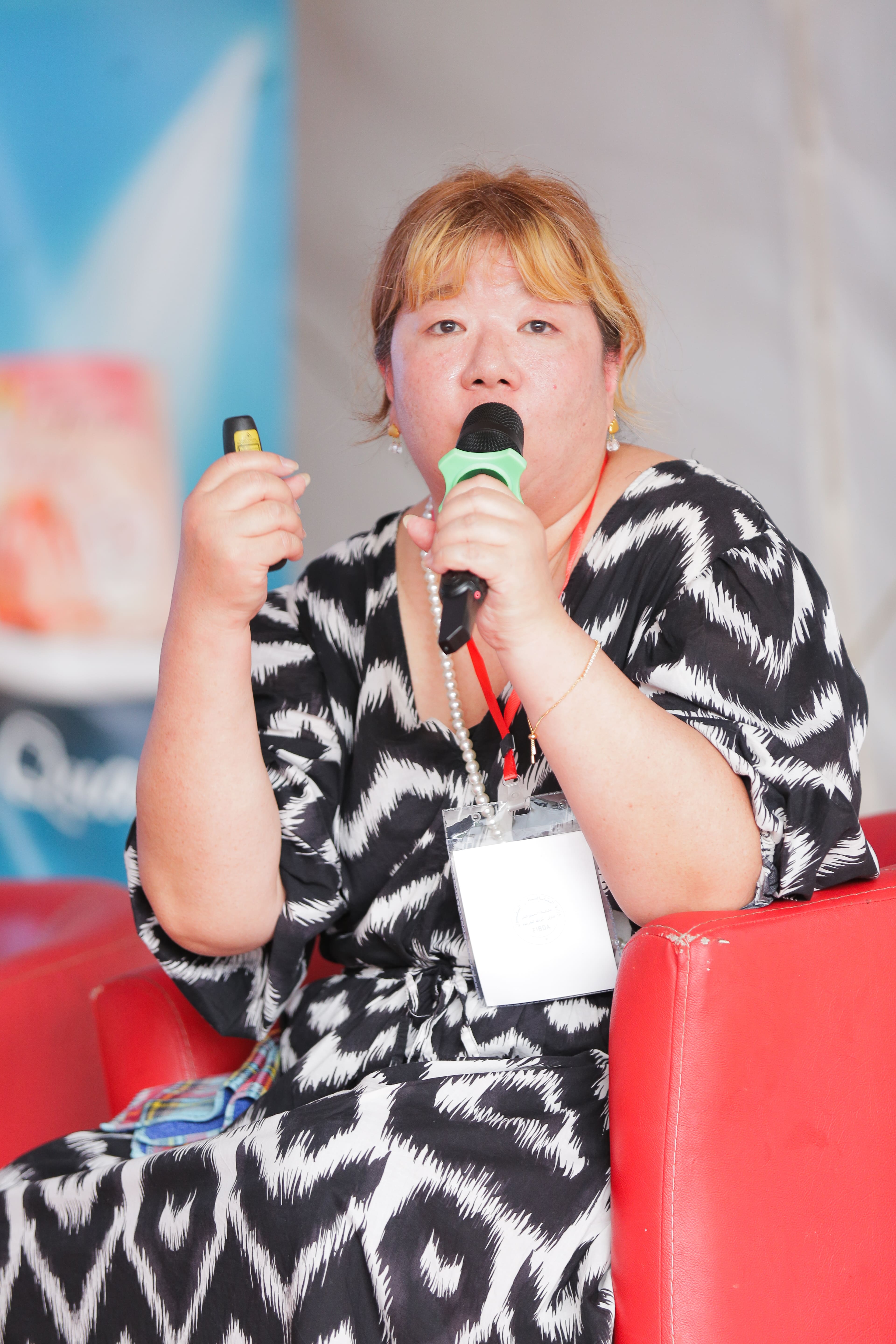
Japanese author, illustrator and manga artist Chie Kutsuwada, who is based in the United Kingdom, gave a conference entitled “From Manga to Graphic Novel” on Friday, October 2, as part of the official programme of the 18th FIBDA. During the session, she looked back on her career, her influences and her approach to artistic creation, while sharing a simple message with the audience: curiosity, perseverance and the right to make mistakes are essential to moving forward.
For nearly an hour, Chie Kutsuwada discussed the different stages of her artistic journey, as well as the cultural worlds that inspire her work. Japanese popular culture, folklore, beliefs, historical narratives and traditional figures occupy an important place in her work, which she nevertheless approaches from a personal perspective shaped by her experience in the United Kingdom and her openness to other forms of artistic expression.
“Weird is cool”
With great generosity, the artist also engaged with questions from the audience, particularly those from young enthusiasts who came to discuss their own artistic aspirations with her. One question concerned the age at which it is still possible to begin a career in manga. Responding to a young man who felt he was “too old” to pursue this path at just 27, Chie Kutsuwada kindly reminded him that he still had his whole life ahead of him and was young enough to start any career, with even the luxury of being able to make mistakes.
Another participant wondered whether her own work might be somewhat too avant-garde. The artist responded with a phrase that became one of the most spontaneous moments of the discussion: “Weird is great, Weirdy is cool.” In other words, strangeness, unconventionality and originality can also be a strength. For her, it was a way of encouraging young creators not to erase what makes them unique.
A graduate of the Royal College of Art in London, where she studied printmaking, and Central Saint Martins, where she studied fine art, Chie Kutsuwada has, over the years, established herself through work at the crossroads of manga, illustration and graphic novels. She is notably the author of Hagakure, The Book of Five Rings: A Graphic Novel, 10 Step Drawing Manga and 100 Tales from the Tokyo Ghost Café. Her work is regularly published by major international publishing houses, and she has collaborated with prestigious institutions and media outlets, including the BBC, CNN and the British Museum.
Chie Kutsuwada also works as an educator and lecturer, helping to pass on this artistic form and introduce Japanese culture to a wide range of audiences. Her books have also been shortlisted several times for the Carnegie Medal, one of the United Kingdom’s most prestigious awards for children’s literature.
Behind the scenes
During the FIBDA session, the artist also explained her working method in detail. For her, creating a work begins with the script. Drawing comes next, followed by a third stage devoted to the details that give the image its depth and identity. This approach reflects her view of manga as both a narrative and visual form, in which every element must find its place in service of the story.
The subject of samurai and the sword, which feature prominently in some of her works, also came up during the discussion. Chie Kutsuwada explained that her interest in samurai was nothing unusual in Japan. On the contrary, this fascination is deeply rooted in Japanese popular culture and forms part of a widely shared imaginary. She thus placed her own interest in these historical figures within a cultural environment where samurai stories naturally coexist with the other major worlds of Japanese comics.
She particularly recalled what she read during her childhood and teenage years: “We could read any manga we could get our hands on, whether it was Cyborg 009, samurai stories or Astro Boy. It was something very natural.”
A twist of fate
Her passion for Shakespeare, on the other hand, stems from a more personal story. The artist explained that her father was not particularly interested in manga, but that he himself was deeply passionate about the works of William Shakespeare. He constantly encouraged her to read his plays.
At first, Chie Kutsuwada was reluctant and politely declined his recommendations, until one day a London publishing house offered her the opportunity to create graphic adaptations of the English playwright’s works. She saw it as a kind of sign from fate, but also as a tribute to her father’s persistent advice.
She ultimately accepted the project and immersed herself in Shakespeare’s work, allowing her to discover a “magnificent world that captivated me, turning this commission into a genuine passion that has continued to inspire me ever since,” she said.
Daring to Begin and Learn
Chie Kutsuwada’s conference at FIBDA was an opportunity to share her experience, but also a conviction: there is no single path to becoming an artist. One has to start, experiment, accept making mistakes and, above all, preserve what makes one’s perspective different from others.
But for her, the most essential thing is education. She advised those wishing to immerse themselves in the field to “seriously take art classes at a specialised school, read extensively, and take language and literature classes, as well as art classes, seriously.”