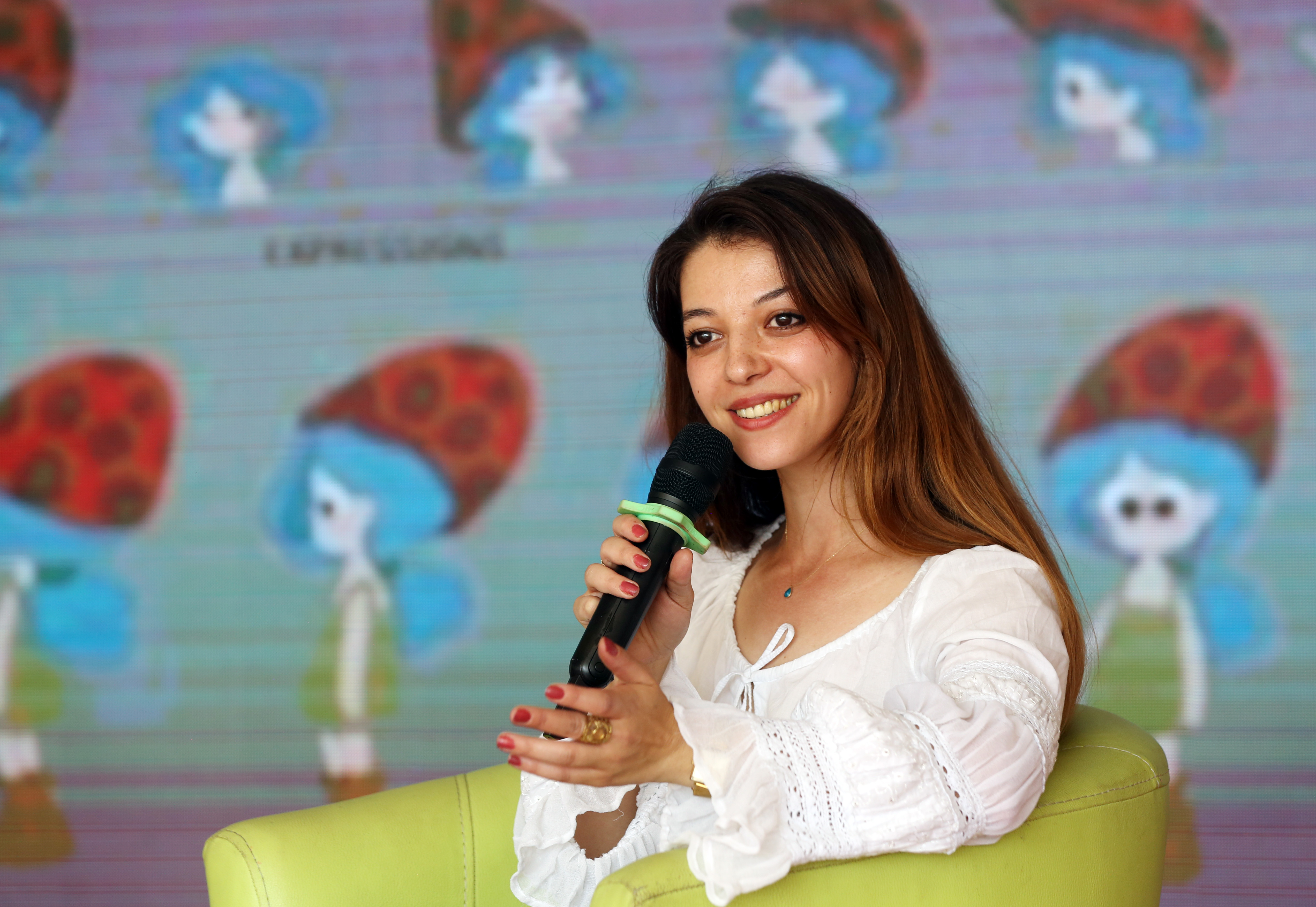
From comics to animation, Bouchra Mokhtari is pursuing the same goal: telling stories in a different way. Invited to the FIBDA for a session dedicated to the transition from paper to moving images, the artist looked back on the creation of her comic book Zozo, her journey in the world of comics, and the reasons that led her to explore both 2D and 3D animation.
Bouchra Mokhtari says her love of drawing dates back to childhood. She particularly remembers the stories her mother used to buy for her, in which she would add her own characters and imagine new scenes. "I've loved drawing ever since I was very young," she recalled.
After obtaining her baccalaureate, a drawing class opened the first door for her. Encouraged by her teacher to enter a competition, she discovered the FIBDA comic book competition online. She then had only one week to prepare her work. Without a graphics tablet and using only coloured pencils and paper, she chose a character that was already featured in her sketchbook. That character would become Zozo.
The character did not win first prize, but received an encouragement award. This recognition encouraged the young artist to keep going. Dalimen Publishing then contacted her and suggested turning the three pages she had submitted for the competition into a full-length album. "I never say no," she said with a touch of humour.
The first Zozo album was thus born. Two more would follow. When she took part in the FIBDA again, Bouchra Mokhtari this time won the Grand Youth Prize. Zozo then became a character that would remain a lasting part of her artistic journey.
The artist explains that her move into animation grew naturally out of her work in comics. For her, images are a particularly effective way of conveying information and a message. "Comics are text with images," she explains, before pointing out that animation takes this even further through movement and body language.
She also spoke about her desire to make a dialogue-free film in which the drawings could be understood beyond language barriers. "I wanted Zozo to speak without speaking," she summed up.
This desire to explore the possibilities of drawing further led her to train in both 2D and 3D animation. She also wanted to learn a new profession and develop her artistic skills.
2D, One Drawing at a Time
During the session, Bouchra Mokhtari also explained the differences between 2D and 3D animation, particularly highlighting the amount of work involved in creating 2D animation. "2D animation in particular is really frame by frame," she explains. Every movement has to be drawn, image after image, with in-between drawings used to make the movement smoother.
She also discussed the role of software, which she believes is often misunderstood. The software does not draw in the animator's place. It is mainly used to bring together the different layers and create movement based on the work produced by the artist.
Bouchra Mokhtari also spoke about her experience at Gobelins in Paris, where she was able to discover traditional animation methods, including large light tables and the layers used to build movement.
To explain the animator's work, she uses the human body as an example. When a person makes a movement, every part of the body does not react at exactly the same time. The pelvis, arms, head and even hair all follow different movements. The animator therefore has to observe and understand these mechanisms in order to reproduce a convincing movement.
Although Bouchra Mokhtari also works in 3D, she says she has a preference for 2D. This is largely because of the freedom that drawing provides. She compares 3D to a puppet that is manipulated through software. The animator needs to know how to move this puppet and understand how the body works in order to avoid overly mechanical movements. In 2D, by contrast, the artist has greater freedom to construct each movement.
"I really like 2D, even though it takes a lot of time," she says. She acknowledges that the technique requires patience and passion, but believes it offers a degree of freedom that she does not find in quite the same way in 3D.
Animation as an Extension of Comics
For Bouchra Mokhtari, the transition from comics to animation ultimately feels like a natural continuation. "Animation is close to comics; it's just that there are more drawings," she explains. She therefore imagines adapting one of her works for the screen as a process that would start with an existing panel and add the drawings needed to create movement. The text would then disappear, giving way to images and, potentially, a voice-over.
This relationship between the two disciplines also explains her interest in animation. Comics give readers freedom over the pace at which they read, whereas animation imposes a movement, rhythm, duration and soundscape determined by the creator.
Music is precisely one of the major differences between the two worlds for Bouchra Mokhtari. In a comic book, readers can choose the music they listen to while reading. In an animated film, music is an integral part of the work and directly contributes to the intended emotion.
She cites one of the projects she worked on with a Swiss artist, in which music accompanies the movements of a couple. To create certain sequences, she filmed herself in order to observe the movements and use them as a reference for her animation.
She points out that this method of observing movement has also been used throughout the history of animation, notably by Disney studios, with people serving as models for animators.
For Bouchra Mokhtari, therefore, comics and animation are not two separate worlds, but two ways of bringing drawings to life. With the first, the reader creates their own rhythm. With the second, the artist adds movement, time and music to extend the language of images.