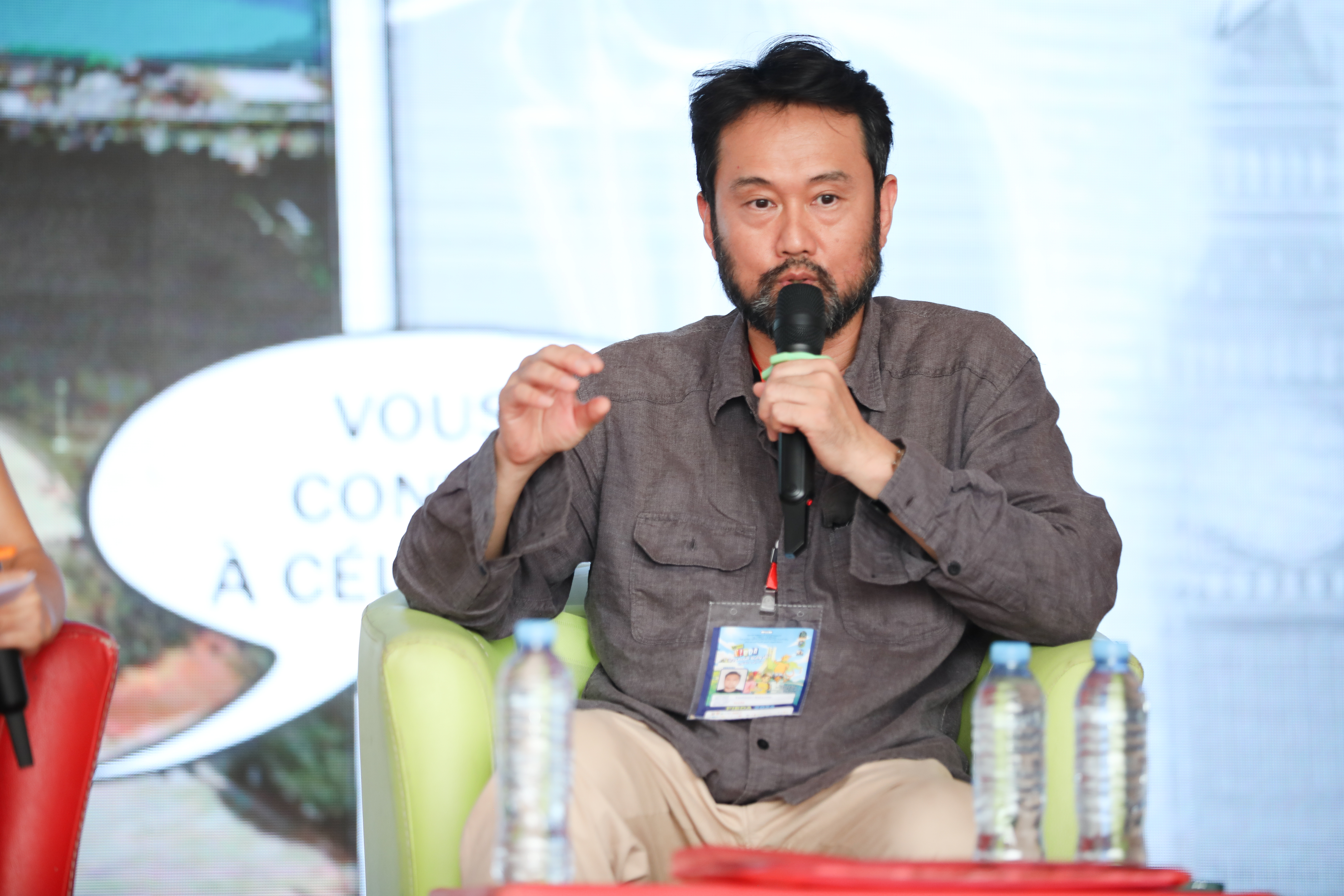
As part of the conference programme of the 18th edition of the Algiers International Comics Festival (FIBDA), Japanese mangaka Natsume Yoshinori spoke on Sunday, October 4, about the major stages of a career that has taken him from manga to video games, from Japan to the United States, and from paper pages to digital worlds.
Born in Hiroshima in 1975, Natsume Yoshinori began his professional career in 1994. His major works include Togari, Kurozakuro, Batman: Death Mask, White Tiger and B-Trash. Several of his manga, notably Togari and Kurozakuro, have been translated and published in the United States, as well as in several countries across Asia and Europe.
Over the years, he has also taken part in major international events, from New York Comic Con and San Diego Comic-Con to Naka-Kon in the United States and the Épernay Comics Festival in France. As both an artist and a writer, he has also ventured into the world of video games, notably at Konami, where he worked on projects related to Metal Gear Solid. In a sense, his career has unfolded across three dimensions: manga, American comics and video games.
Asked about his view of manga and whether he considers it an art form, the mangaka explained that, as a mangaka and an artist, “for me, it’s simply manga. Of course, for other people, it can be considered art. But for me, it’s simply manga. It’s not something sophisticated.”
Nor does he consider himself a manga specialist. “I didn’t study manga as an expert, but I have a good relationship with this world. Ever since I was a child, I learned to appreciate manga. So I would simply like to explain to you how manga emerged in Japan and how this world has evolved,” he said.
A Childhood Shaped by Manga
His personal story is closely intertwined with this evolution. Born in the mid-1970s, he belongs to a generation that grew up alongside the simultaneous rise of manga, Japanese animation and video games.
“At that time, extremely popular manga aimed at the general public, such as Doraemon, already existed, and anime was being broadcast on television. Manga was therefore part of children’s everyday lives.”
For him, this familiarity with manga also provided a way to escape during a childhood marked by asthma problems and frequent hospital stays.
“I often had to receive intravenous infusions for long hours in hospital. I remember my parents buying me manga at large bookstores,” he recalled.
It was also during this period that Dragon Ball made its first appearance in the pages of Weekly Shonen Jump, a publication that young Yoshinori eagerly looked forward to every week.
At the same time, home video game consoles were beginning to make their way into Japanese households. Mario and other pixelated heroes thus joined paper characters in the imagination of a generation.
“I think I belong to a generation that grew up with the development of manga and video game culture. I have always loved manga, and I was constantly drawing them when I was a child,” he said.
In Hiroshima, however, the dream of becoming a mangaka still seemed a long way off. “I lived in Hiroshima, which is quite far from Tokyo. To me, a mangaka was someone as inaccessible as a movie star.”
Among his influences were Akira Toriyama, the creator of Dragon Ball, and Yudetamago, the duo behind Kinnikuman.
Determined to get closer to this world, Natsume Yoshinori chose to attend a university near Tokyo. He then began working as an assistant to mangaka Ryōji Minagawa, an experience that allowed him to discover the inner workings of manga creation.
“That was around the time the PlayStation came out. Between tasks, we would sometimes play together,” he recalled.
His career then took an unexpected turn when he joined Konami, one of the major names in Japan’s video game industry. He worked on projects related to Metal Gear Solid, a professional experience that introduced him to another creative language and allowed him to appreciate the growing importance of digital technology.
The Rise of Togari and the International Stage
In 2000, he eventually left the company to return fully to manga and began publishing Togari in Weekly Shonen Sunday. The story follows a criminal who is given a second chance: he has 108 days to seek redemption with the help of a mysterious magical sword.
The publication of Togari also marked a new stage in his international outreach. In 2003, he was invited to France to a festival organised by publisher Delcourt.
“It was the first time I had taken part in an event dedicated to manga abroad,” he said.
The experience allowed him to see first-hand the growing international popularity of Japanese manga.
The internationalisation of manga has gone hand in hand with profound changes in the Japanese market itself. The fate of a series can sometimes depend on highly pragmatic editorial decisions.
“Japanese manga always follow the publisher’s decisions. The ending of a series can simply depend on the decision of the editor or the publishing house,” he explained.
After Togari and Kurozakuro, Natsume Yoshinori also found himself working on a character whose reach extends far beyond Japan: Batman. For DC Comics, he created Batman: Death Mask, a work that opened the doors to the world of American comics.
The collaboration also allowed him to begin using digital tools to send his pages from Japan to the United States, at a time when such exchanges were gradually becoming easier and faster.
From Hiroshima to Tokyo, from manga pages to Konami’s consoles, and then to American comics and international conventions, Natsume Yoshinori has ultimately crossed several worlds without ever truly leaving the same universe: the world of imagination.